Tuesday, March 13, 2012

Electronic and Computer Music

I made up my mind: I dropped this class. There was no fun in it anymore, and this electronic music stuff just became too much nonsense. Our next assignment was to create a piece of "Music Concrete," a french style of creating music based on recording various non-musical sounds and clipping them together in some random fashion and then claim it to be "music." The assignment coming up after that was all about creating noises artificially, and then do the same to them. No, I'm glad i dropped it.

However, I did get to create these two pieces for my first assignments:

Saga

Holmes

Amusingly, shortly after releasing these tracks on Soundcloud, I was contacted by a guy named Ryan Kintz (from a company called "Afton Feedback") who asked me for booking information. This was of course too good to be true, and after a bit of research I found out that Kintz makes a living basically by charging bands for giving concerts.
The Rex Theater, Pittsburgh
Some people called it a scam, but at least it seems like a pretty fair scam.

I would love to play at The Rex Theater sometime, mr Kintz, but only if you could convince me people would actually come. Also, I probably need more than a soundcloud account and an internet connection in order to actually give a performance. Some ridiculously oversized headphones, a broken record player and a sidekick with blonde spikes would do good for starters.

Sunday, February 26, 2012

Why do we work?


My heart is in the work
 - Andrew Carnegie


Update: Full video now available! See end of blog post.

There was a great event today! A group called the The Veritas Forum* had invited four professors with different perspectives to discuss the meaning of work, the universe and everything. One of the professors was my employer David Kosbie, whom I have been working with for three semesters (or four, if you count the semester when I took his course), and he presented a "pragmatic humanistic" view on work ethics. Along side him was the Christian, Mike Smith, and the agnostic Marie Norman. Paul Johnston was moderating the debate.

* The Veritas Forum was sponsored by InterVarsity Christian Fellowship, Asian Christian Fellowship, Newman Club, New Life, Knowing and Understanding the Passion of Christ, Graduate Christian Fellowship, Lutheran Student Fellowship and Fellowship of Christian Athletes. Co-Sponsors were the Student Senate, Student Life, Student Affairs, Life Matters, Impact, Agape, Awareness of Roots in Chinese Culture, Society of Women Engineers, Asian Student Association, Lambda Sigma and the Muslim Student Association.

The conversation, as it was called, was great. All of the professors had great insights and stories, and I could nothing but agree with all of them. Of course, I was familiar with Kosbie's strong work ethics, which I keep in high regard, but I was also deeply impressed by the views of professor Smith and professor Norman.

Kosbie was the strongest defender of hard work, which in his experience leads to greatness and fulfilment. However, being motivated by grades, money or status is ridiculous; no, hard work must be motivated by that inner passion that is somewhere inside of there. The hard work we do at Carnegie Mellon is not the goal in and of itself, but it is what we choose to do with the tools we learn here that brings the greatness about. For instance, only this last week, Kosbie had received e-mails from several former students involved in great projects were they applied their programming knowledge to save babies. That is fulfilment and life quality right there, and it is possible because of the hard work these students pour into it.

At the other end of the conversation was Marie Norman, who brought up the point that the second most common regret on our death beds is "I worked too hard." She argued that it is important to find a healthy balance between work and leisure, and that the most important things in life might not be related directly to work, but perhaps to play, rest and family. When asked if her view on work would have any application in personal relationships, she said that some distance might be good sometimes in marital relations as well. You get a different perspective if you put work a certain distance away, and that distance may even help you do your work better when you are there.

Paul Johnston had a short anecdote in which he philosophised over the noun work as used in his field of study, music. In music, you create a work, and you can read and comment on someone's works. Funny thing is, when you perform a work, you play it...

Mike Smith presented a view on work which was very strongly dependent on his Christian faith. As opposed to other religions and the concept of "karma" found in most world-views in some form or another, Jesus says that we by grace are accepted without respect to our works. Whereas the idea of karma dictates that you are judged according to your works, grace doesn't put that kind of fear-like pressure on people. The motivation for doing any work at all is then found in the joy of it. He illustrated this by a quote from the movie Chariots of Fire, where a Christian runner responds to accusations of him caring more about his work than about his faith:

"I believe God made me for a purpose. But he also made me fast, and when I run, I feel his pleasure."

The questions that were asked afterwards were also tremendously great. I don't even understand how people come up with such great questions! For instance, a question addressed to Kosbie was "What if you keep working hard, but never see any success in your endeavours?" Such a great question! Another great question was "how should your philosophy on work be reflected in your personal relationships?" In response to these and other questions many more interesting topics were brought about, such as the community that hard work will create (for instance, Kosbie's class has a very strong community).


By the way: I recorded, mixed and mastered the soundtrack of the video above. Great times with Kwadwo and friends. Also: great job catching Kosbie on film, Kwadwo!
Also: Kosbie just recently won the Herbert A. Simon Award for Teaching Excellence. We (CA's and tutors and everybody) are all very proud to be on his team. Congrats, David, you deserve it!
Thirdly: (or fourthly?) Great job, and thank you so much to everybody who volunteered to make the Veritas Forum happen. I'm so glad I know you all! Thanks also to the panelists for making this such a great and honest conversation.


CMUVeritas
Kosbie.net
Department of History: Marie Norman
Heinz College: Mike Smith
School of Music: Paul Johnston
Wikipedia: Chariots of Fire

Wednesday, February 8, 2012

Boarding Airplanes Simulation

In lack of anything deep to write about, I decided, wait... In spite of the overwhelming amount of deep topics to write about, I decided to write about this project I'm doing in one of my classes: I'm writing an airplane boarding procedure simulator. It is only a small project, and it is due this Thursday. It is nothing big, just fairly interesting.

(Strangely, there has also been a request for technical material on the blog)

If you have ever travel by air on a regular basis, you most certainly have wondered at some point or another why boarding the plane isn't more efficient. Well, I certainly have. Whenever I have to wait for a guy to store his luggage in the overhead bin, and there is plenty of room behind him, I get this sense that I should have boarded first. But how much time can we possibly gain by boarding in a non-randomized order? Well, this simulator aims to compare different strategies.

To start off, let us create a plane with seats and an aisle, and then let the aisle extend out of the plane and up to that boarding arm hallway thing that takes passengers between the airplane door and the actual terminal building. Then we fill up this arm with a line of passengers; each passenger is given a ticket, either at random, or sorted by whatever algorithm.

Now that we have lined all the passengers up outside the aircraft, each passenger will try to move towards their seat; at first, however, only the very first person in line can actually move! So what do the other people do? Well, they wait until the person in front of them has moved away, which of course takes some time. Then the next thing to consider is when a man has reached his row, he will use extra time to sit down, holding up everybody waiting to get past this point, and also holding up those waiting to get to a row that is occupied by the line of people waiting to get past that man who was sitting down. Now, if the man has a window seat, it may take longer if there is another passenger sitting down at the aisle seat...

It all turns out to be a big scheduling problem, but it is also a somewhat interesting model; each individual person exists inside the plane (in the aisle or in a seat), but it is also the actions of the individuals that change the state of the plane. The individual persons themselves will schedule their own actions based on their target seat and their environment, and some actions (i.e. movement) will change the state of the plane as well as the passenger. Actually, it turns out that most actions are simply to schedule a rescheduling while waiting for something to happen. It is like, writing down in the calendar that one ought to update the calendar. It all got juggled up in my head, at least...
I do have it working by now, but not elegantly, and I haven't generated any interesting line orderings yet. We'll see how it goes. Also, it has clearly been a while since the last time I used Java, so referring to the notes of my old introductory course has been invaluable. So what is the most efficient way to board a plane? I might find out tomorrow.

Thursday, November 24, 2011

Radiate and Dance

I dunno why I chose this as the title of my song - maybe because I am divided in the question on synthetic music. In any case, this is my first ever fully synthetic piece. Still, I tried to keep it sounding somewhat natural, which was surprisingly difficult.

Song was made as a part of the course "Introduction to Music Technology" at Carnegie Mellon. We used the software Reason.

Monday, August 1, 2011

Why Breivik may still win

After the horrendous attacks in Oslo and Utøya, Norway has been united in hope and sorrow. Our leaders have repeatedly stressed that we will remain an open and friendly society, and that we should not be frightened. "The answer to the attacks must be more democracy and more openness," said our PM Stoltenberg repeatedly in the news, sincerely and well intended. "If not, then those who were behind this will have achieved their goal." The terrorist seemingly doesn't want democracy or openness; but in response to his terror, that is seemingly exactly what we are going to give him.

But: the entire argument may be upside down.
It could be that Breivik felt that his voice was ignored. It could be that Breivik were angered and frustrated that his viewpoints were locked out of the public debate. It could be that the cultural conservative ideologists and Islam-critics actually want more openness and democracy. Now, Stoltenberg is claiming that we will meet this attack with more openness and democracy. However, it might be the case that the viewpoints of cultural conservative ideologists and Islam-critics are even more stigmatized and outlawed than ever. Yes, it might even be the case that such stigmatized people will be angered and frustrated.

There is no basis for democracy when all patriots and nationalists are ignored, ridiculed or persecuted.
- Anders Behring Breivik

First of all, a word about the opinions of terrorist Anders Behring Breivik: they are not wildly uncommon. Surely, Breivik is going way far in his manifesto, and to most of us he would also be an unpleasant encounter in an internet debate. But the general idea that Islam is dangerous and growing in the West at an alarming rate is not uncommon. The idea that we should revitalize Christianity in the West on the expense of Islam and in some cases secularism is not uncommon. And the arguments that the most sophisticated among the cultural conservatives are perpetuating are not as stupid or ungrounded as the left-center spectrum of politicians and commentators portray them to be.

This fact should not disturb any of us more than just slightly. Because even though they are many, they are averagely sensible and empathetic people. Heck, they might even have a point or two. Unfortunately however, there is already a certain stigma towards cultural conservatives, something that by nature screws up the brains of the people in question; if you isolate a voice from the debate, its viewpoints will miss the corrections from other ideas, and will grow to a beast like a forsaken hedge. It may create for itself an entirely isolated worldview.

Screenshot from Breivik's
YouTube video
Breivik had obviously lost his faith that traditional politics in Norway would have any effect, and his worldview had had the time and space to grow into something very different than ours. He even came so far as to see himself as a sort of commanding templar knight in his own fairytale. But Stoltenberg is wrong when he suggests that the terrorist did not want democracy at all. In his manifesto, Breivik underscores that he indeed supports democracy, but also that the democracy of today is not legit. His reason is primarily that schools and media are biased, so that cultural conservatives like him are ridiculed and locked out of public debate. Such arguments are clear signs that he feels stigmatized by the power elite.

Still, cultural conservatives are being further stigmatized by this event as we speak. In many of the speeches that are held, people are condemning not only Breivik's horrendous actions, but also his political opinions. In times of sincere sorrow they forget that a significant amount of people have similar views to Breivik, and that they too may be mourning over this terrible tragedy. I only see that such speeches will stigmatize and isolate the broader group of cultural conservatives further. (The spirit of unity and brotherly love that this country is experiencing right now does not really welcome everybody, does it?) I fear that such an atmosphere could indeed recruit more extremist templar knights. Then Breivik will win.

So in light of the applauded stand of our Prime Minister, I find it ironic and slightly troubling how sincere voices on the relatively sane side of politics are advocating that Breivik's manifesto should be ridiculed and silenced. Google is even working on changes in its algorithm that will make it difficult to locate the manifesto online! This is precisely the opposite of what Stoltenberg was celebrated for suggesting as a response, namely more openness and more democracy. This feels more like censorship and manipulation.

I suggest that we actually follow up the words of our dear Prime Minister. I suggest that we indeed meet this tragedy with openness and democracy. Then let us not embrace tools of censorship and surveillance, but rather remember that more openness and democracy includes welcoming both cultural conservatives and fundamentalist Muslims to the honest debate. This, I suggest to you, is the better way to fight violent extremism.


More:
Warrior of Agape: Is Anders Behring Breivik a Christian?
Dr Robert Ford: What do we know about Anders Behring Breivik? Very little

Tuesday, July 26, 2011

Is Anders Behring Breivik a Christian?

My simple and uneducated reflections on the Oslo bombing and shooting at Utøya, the terrorist Anders Behring Breivik, his manifest, his religion, and Christianity.

When I first heard about the Oslo bombing last Friday, I was afraid. I was afraid it was some sort of fundamentalist Muslim who had done it. I genuinely hoped it was not by Muslims. I was afraid that the Norwegian society would become paranoid and hateful if it was. So in some sense, I was relived as the Muslim theory became less and less likely, and eventually culminated when a friend posted his name and profile on Facebook: Anders Behring Breivik
I have long suspected that ultra-conservative Christianity is of equal concern to public safety as Muslim fundamentalism is. Though not surprised, I was outraged and deeply saddened. Maybe even more than I would have been had it been Muslims.

Of course, I told myself, this man cannot truly be a Christian. That was the reaction of some of my pastor friends on Facebook as well. "The atrocity in Norway is not the action of someone who has a genuine relationship with Jesus Christ," said one, another said, "I do not acknowledge him as a brother, because his actions clearly shows that he is not a Christian, that is, a follower of Jesus Christ." A third pastor stated, "He was as much a Christian as he was a policeman," referring to his costume during the massacre.

I decided I could not conclude with any of that yet, though I of course appreciated the idea. Well, it could actually be that Breivik was a man of serious faith, such as the Christian fundamentalist Scott Roeder who killed an abortion doctor on 30 May 2009. His victim was only one of eight people killed over the abortion issue in the US in the last two decades. We thus have enough examples of people of devote faith that are being violent in deed, heart or word by today's standards. Not to mention the many screwed up ideas that Christianity, including popes, "church fathers," and devotees, has had over the last millennia and a half. I could not be certain.

At some point I decided to find out what Breivik said about the matter himself. I started by watching his 12-minute video introduction to his manifesto. About ten minutes into the video, I found signs of what I was looking for, where Breivik is distinguishing his organisation "Knights Templar" from other Christian organizations:

  KT is a “cultural Christian” (Christian Identity) military order and NOT a “religious Christian” (Christian fundamentalist) organization. Logic and reason will always take precedence over biblical texts. KT is open for members from all denominations of Christendom, even agnostic and atheist Christians. Our Christian profile does not mean that we oppose Odinism or Odinistic principles. KT believe Odinism make out a central and important part of Northern European culture and traditions.

We thus start to see that maybe my pastors were right in their immediate analyze of Breivik. Reading in the manifesto, the culturality/secularity of Breivik's Christendom is repeated, and he is also citing entire articles in which the nationalist blogger Fjordman is discussing whether Christianity is supporting or opposing "the issue." Fjordman is underlining his non-religious standpoint in the discussion many times, and in sum I think it is pretty safe to assume that also Breivik embraced this position. It is clear that Fjordman is less concerned with the actual truth-value to a religion, and far more interested in its practical effects. These are excerpts of what Fjordman is writing:

  Although not a religious person myself, I am usually in favor of a revitalisation of Christianity in Europe. However, I sometimes have my doubts when I see how many, too many, church leaders consistently end up on the wrong side of issues related to Islam and Muslim immigration.
Fjordman, The Church – Part of the Problem or Part of the Solution?

  As long as there is separation between religion and state, those of us who don't have any religious belief should prefer religions which tend to create reasonable and prosperous communities. Our traditional Judeo-Christian religions have proven this capability. Islam never has, and probably never will.
Fjordman, Thou Shalt Hate Christianity and Judaism

(I would like to pause for a moment and consider the role of Fjordman and other unaware contributors to Breivik's manifesto. Remember how sometimes it feels embarrassing if someone of your friends or one in your family does something inappropriate, like, your little sister refusing to eat the food in a fine dinner? Remember how I felt angrier with Breivik than I would have felt with Muslim terrorists? Now consider how angry Fjordman must be about Breivik killing his own people and thus bringing great disgrace to their names and reputation. So even when we strongly disagree with him, let us not blame him for an act of violence he probably hates and condemns.)

In Breivik's manifesto, he himself makes a point out of the difference between cultural Christendom and religious Christendom. In the words of Breivik himself:

  If you have a personal relationship with Jesus Christ and God then you are a religious Christian. Myself and many more like me do not necessarily have a personal relationship with Jesus Christ and God. We do however believe in Christianity as a cultural, social, identity and moral platform. This makes us Christian.
(p. 1309)

Thus, I can conclude with pretty high certainty that this man is not a Christian in my and most people's sense of the word. As it turns out, I am even the worst kind of Christian this guy can imagine:

  The pacifist/suicidal Christians must never be allowed to dominate the church again which one of the reasons why I personally believe that the protestant Church in Europe should once again should reform to become Catholic.

(I think by suicidal we can assume someone who is willing to give up his own life and rights and rather turns the other cheek :-)

Despite that Brevik underlines his unreligious Christianity, he does include an extensive theological defence for the use of force and sword, primarily based on the Old Testament (with a few weak supporting verses from the New Testament). He goes on to discuss how he planned to become religious in time of fear, somewhat as the rational thing to do.

  If praying will act as an additional mental boost/soothing it is the pragmatical thing to do. I guess I will find out... If there is a God I will be allowed to enter heaven as all other martyrs for the Church in the past.
  I am pursuing religion for this very reason and everyone else should as well, providing it will give you a mental boost. There is no shame in praying minutes before your death. (...) Sure, many deny God now. But when they're looking death in the face, when they're sick or in an accident or staring down the barrel of a gun, they'll change their mind. They'll beg for God then. There are no atheists in foxholes.
(p. 1346)

Even though it is clear that Breivik was no current follower of Jesus Christ, he were still using the label Christian, and in some sense he used violent theology to justify his actions. The church certainly got some new challenges in regards to liberal hostility. However, I find it comforting to see how an entire population still have been seeking to the church in this difficult time. I am also proud of my government for propagating the true Christian ideals when faced with such horrendous evil.

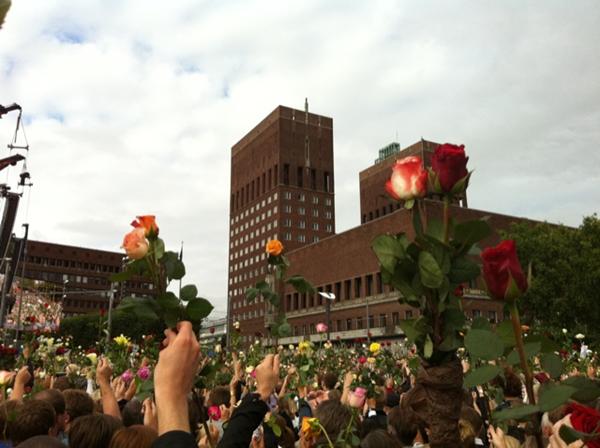
  Tonight, the streets are filled with love.
  We have chosen to answer cruelty with intimacy.
  We have chosen to answer hatred with brotherhood.
  We have chosen to show what we stand for.
Crown Prince Haakon

  Hatred is an evident feeling. A wish for revenge is a natural reaction.
  But we, Norway, shall not hate. And we shall not seek vengeance.
  We shall stand united. In sorrow, in hope and in faith in what the youth at Utøya fought for: A better society
  (...)
  The Norwegian people have met hatred with love.
Eskil Pedersen


More:
Warrior of Agape: Why Breivik may still win

Friday, December 3, 2010

Everything matters

It matters how it is built. It matters how the electrons are moving through transistor to form gates, final state machines, processors, operation systems and computers for use in industry and in our homes. It matters how the atoms and molecules are holding on to each other to create the taste of pineapple and chocolate. It matters how gravity is holding us in place, and how the speed of light is related to space and time.

Academics matter. Philosophy matters, history matters. Discussions about life, the universe and Douglas Adams matter. Science matters, sociology matters, medicine matters, law matters, computer science matters, yes, even politics matter. At least a little bit. Engineering matters.

It matters if there is an airbag in the car. It matters what energy rating your house has. The quality of the wood; the sharpness of the knife; the accuracy of the pencil; it all matters. How the chair is formed, how hard the mattress is, how many birds you can count on one hand.

It matters how white blood cells and doctors are eager to heal us from terrible diseases. It matters if we wash our hands. It makes a difference if we walk to work, if we take the stairs and where we go hiking. It matters. What we watch on TV, what we buy in the grocery store, what we do for a living.

Who we chose as our friends. Who we chose as our girlfriends and boyfriends. It is actually important. It matters also how we treat our friends. Heck; it matters how we treat our enemies! It matters that we visit grandma. It matters that we say hi on Skype once in a while. Skype matters.

The words we say. The blogs we write, the comments we leave. The conversations we have. Words have matter. As WikiLeaks so eloquently have shown us, words is the most amazing matter. Because words are always more than just words; words are feelings, agendas, love and hatred. Words really matter. But hearts matter even more, for the mouth only speaks what the heart is full of.

Attitude matters. How you dress, what shoes you wear, if you hold your head high when you walk down the street, if you look people in the eyes when you shake their hand. What seat you choose in the bus. What perfume you wear. How much makeup you use. How you do your hair. What tone you use in your voice. How genuine you are when you say you care.

The birds in the sky matters, as do the fish in the sea, the mammals of the earth, the reptiles, the dinosaurs, the bugs, algae, mushrooms, and every tree and every flower. Every star at night, every drop of rain and every ray of sunshine. Everything matters.

You matter.


Can I matter together with you?